The Nine-Day Wonder: The Vegetarian Festival of Phuket For nine days in early autumn, the entire center of Phuket town becomes a showcase for Thai-style Chinese vegetarian cooking. For maximum access to vegetarian meals in Thailand, this is as good as it gets.
The Big Picture: Searching for vegetarian meals (Chinese or other) in Thailand is an ideal method for dispelling the misconception that vegetarianism is common among those practicing Buddhism. As discussed in the introduction, the scriptures of the Northern School of Buddhism expressly forbid the eating of flesh but those of the Southern School do not. The mainstream of Buddhism practiced in Thailand is that of the Southern School. Although periodically someone of prominence embarks on a crusade of vegetarianism and sparks interest, vegetarian eateries seem to come and go. Nonetheless, perseverance can be rewarded with dishes found nowhere else.
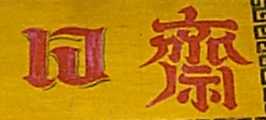
Searching...: Outside of Bangkok, Chiang Mai, and Phuket (cities with Thailand's most visible Chinese communities, as well as tourism areas) vegetarian eateries following the restrictions of the Chinese style (no onions or garlic) can be difficult to find. In Thailand, the zhai (not su) character is always used, along with the Thai character as in Figure 1. In the Thai language it is called jay, which many Thais incorrectly use for all vegetarian. The correct Thai word for general vegetarian is mangsariwat. I've never had problems requesting jay meals in mangsariwat eateries (that served more than pre-cooked). In non-vegetarian eateries, however, the staff was not always aware of the distinction.
A 106-page pocket-sized book of places to get vegetarian food in Thailand is available, including places with a vegetarian menu and those with raw material for vegetarian food. It includes phone numbers, along with names and addresses in English and Thai (useful for taxis). I found it in Phuket (cost less than US$1), but the back cover lists a Bangkok phone number (662-873-1049), so it may be published and distributed there.
For the Bangkok area, 117 vegetarian shops, plus 46 places with a vegetarian menu, are listed! The #2 and #3 cities with the most listings are Thailand's second and third most populous cities: Chiang Mai with 53 vegetarian eateries, and Nakhonratchasima (Khorat) with 11. Chiang Mai is much more compact than Bangkok and hasn't yet replicated Bangkok's infamous traffic sludge, so in Chiang Mai you have a much better chance of actually arriving at the eatery before closing time. Khorat receives few tourists, other than those few heading for the ruins at nearby Phimai (which may explain why the locals there were some of the most gracious hosts I've encountered).
Some online assistance:

Vegetarianism in Thailand is a light-hearted compendium of tips for travelers to Thailand
Vegetarian Restaurants and Food Shops in Bangkok includes my Thailand favorite, Vegeta (formerly Vegetarian Cottage in World Trade Center). Also includes useful links.
Thai-Info provides a search engine for Thai restaurants. Choosing category =vegetarian and province=Bangkok yields the 5 restaurants listed at the above site plus an additional one.
WTCMCR lists 5 Chiang Mai vegetarian eateries.
ChiangMai-Online has a search engine for Chiang Mai that pulls up a few vegetarian spots.
The Food
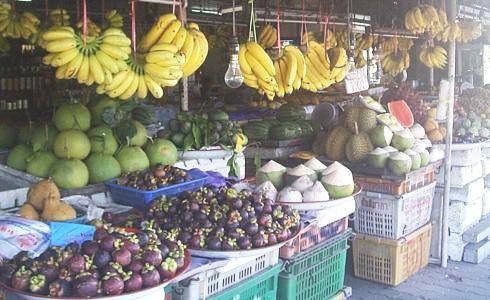
Names? We don't need no steenkin' names
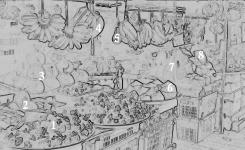
Mangosteen ("Queen of Fruit"), no relation to mango.
??
Pomelo (also called grapefruit) - a larger and sweeter variety than that found in US.
Banana: many varieties available
Lightbulb (technically, not really a fruit)
Cocoanut (really a nut, which is technically a fruit)
Durian ("King of Fruit"):
It has a hard prickly rind, containing a soft, cream-colored pulp, of a most delicious flavor and a very offensive odor.
--Webster's Unabridged Dictionary Watermelon, available throughout the year
Note: The image below is a continuation of the one above - the camera couldn't capture the entire fruit stand in a single photo.
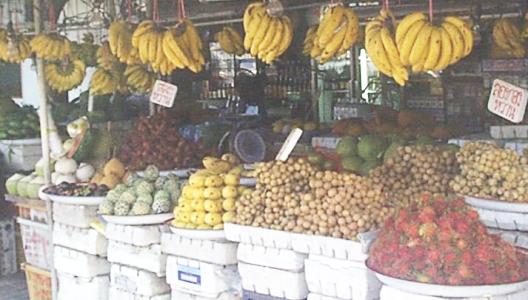
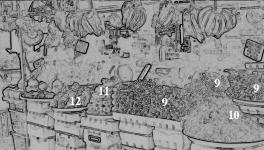
Three varieties of long gong: similar to longan and litchi (also written as lichi or lychee)
Rambutan, also related to litchi, grows in abundance and at season's peak is virtually given away.
Mango, one of many varieties that are available when in season
??
Beware of Farang Food!  The Northern School Buddhist scriptures that set the rules for eating warn against particular pungent plants. The rationale given was that those seeking a state of clear attention should avoid foods that inflame the passions. Since the scriptures are said to date from some time before the 6th century, there is no mention of chili (a stimulant so strong it was formerly believed to be an aphrodisiac): chilies were unknown in Asia until they were brought there by Portugese traders in the 16th century. Whether jay cuisine obeys the spirit of the law, is protected under a "grandfather" clause, or is exploiting a loophole is a question of doctrine we shall leave for the experts. The concern here is how to prevent unwanted mouth volcanoes (If you believe that you've paid your dues with ample experience in the Thai restaurants of US or Europe, you are in for a surprise). There are two main defenses:
|
Another distinquishing feature of Thai cuisine is the flavor. Chinese cooking is based on balancing the five flavors: bitter, salty, sour, sweet, and pungent. In Thai meals served in stalls, shops, and restaurants sweet and sour (and, of course, the pungent chili) tend to dominate.